tabane.dev
Bind Claude, Codex, and Gemini into one terminal: route each task to the agent that fits, and reroute before any rate-limit window runs out.
- Status
- Open source and in alpha, usable today. A 1.0 release lands by September 2026.
- Tags
- Terminal · AI agents · Open source
Why I built it
I did not build tabane to launch it. I built it because I was tired of being a dispatcher in my own head.
I pay for three coding agents, Claude, Codex, and Gemini, and for a while I had all three open in three terminals, spending half my day deciding by hand which one got what. This is a refactor, give it to Codex. Claude is almost out of its window, hold that. Gemini has room, send the docs there. Each one has its own five-hour window, its own quota, and its own way of hitting a wall in the middle of the thing you actually care about.
So I wrote a small thing to do the dispatching for me, then a slightly less small thing to predict the limits, and then it just became how I work. I have been running it daily for months. When Sakana put out Fugu and it never opened in the EU, a few people asked me what I use instead. This is what I use, so I spent a couple of weekends sanding off the rough edges and put it out.
The name is the whole idea. 束ねる, tabaneru, is the act of taking a fistful of loose cord and binding it into one clean bundle. That is what this does to your agents.
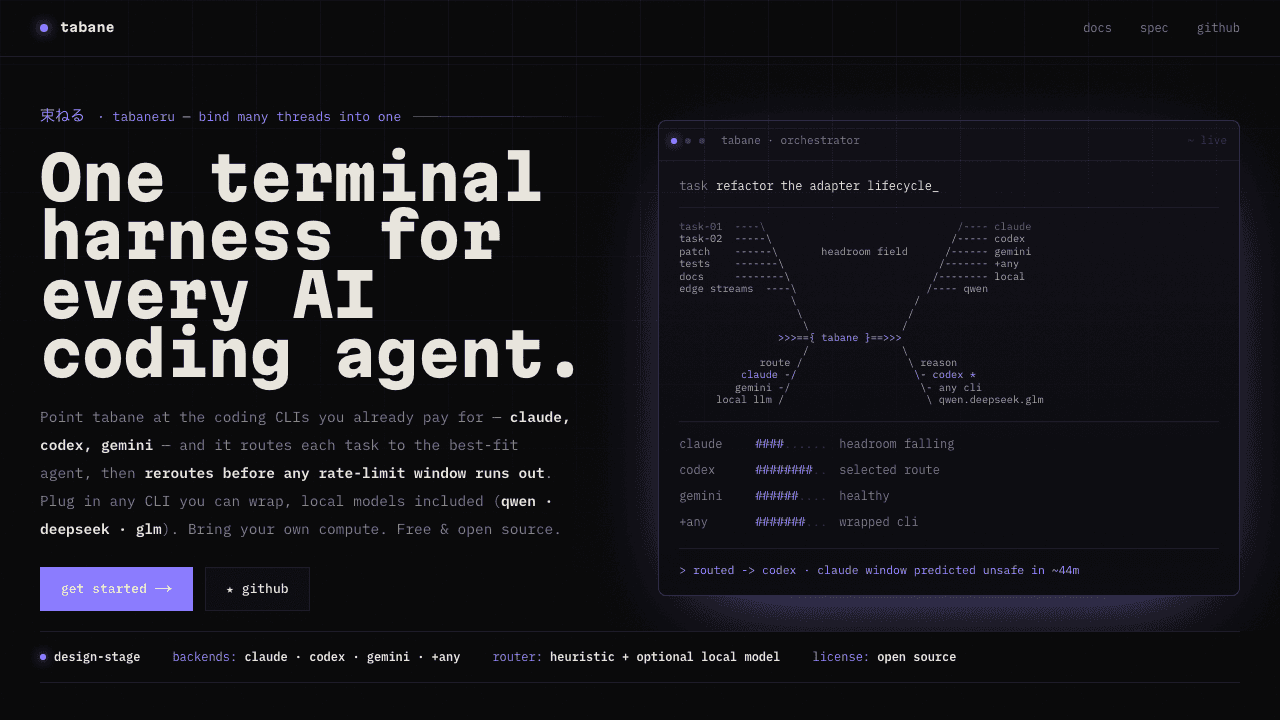
How it works
tabane points at all your agents at once and treats them as one pool. It reads each task and sends it to the one that fits: tests and careful debugging to Claude, fast mechanical refactors to Codex, long-context work and docs to Gemini. The part that makes it tabane and not just a load balancer is that it watches how fast each window is burning and treats "about to run out" as a routing signal, so it moves work to a fresh backend before you hit the limit instead of after the request fails. Every decision is logged with its reason, so you can always see why a task went where it went.
You drive the whole thing from one terminal. The compute is yours, it runs on your own keys, and nothing leaves your machine that you did not already send. It is free and open source.
Where it is
Alpha, and genuinely usable today: I run it daily. The core is all there, the backend adapters, the usage and limit math, the router with proactive rerouting and circuit breakers, and a live TUI you can drive. Still to land: verified per-provider quota probes, smarter routing, parallel runs, and a proper release binary. A real 1.0 goes live by September 2026.
Cheers.